«Growth mindset and socioeconomic inequality in academic achievement across seventy-three PISA countries» by Joan E. Madia, Rob J. Gruijters, Isabel J. Raabe & Nicolas Hübner
A new analysis of PISA 2022 data from 73 countries shows that having a growth mindset, which means believing that abilities can develop with effort and practice, has only a minimal effect on achievement differences. It accounts for about 3 percent of the socioeconomic gap in academic performance. This means that mindset plays a very minor role, and changing students’ beliefs on its own will not substantially reduce educational inequality.
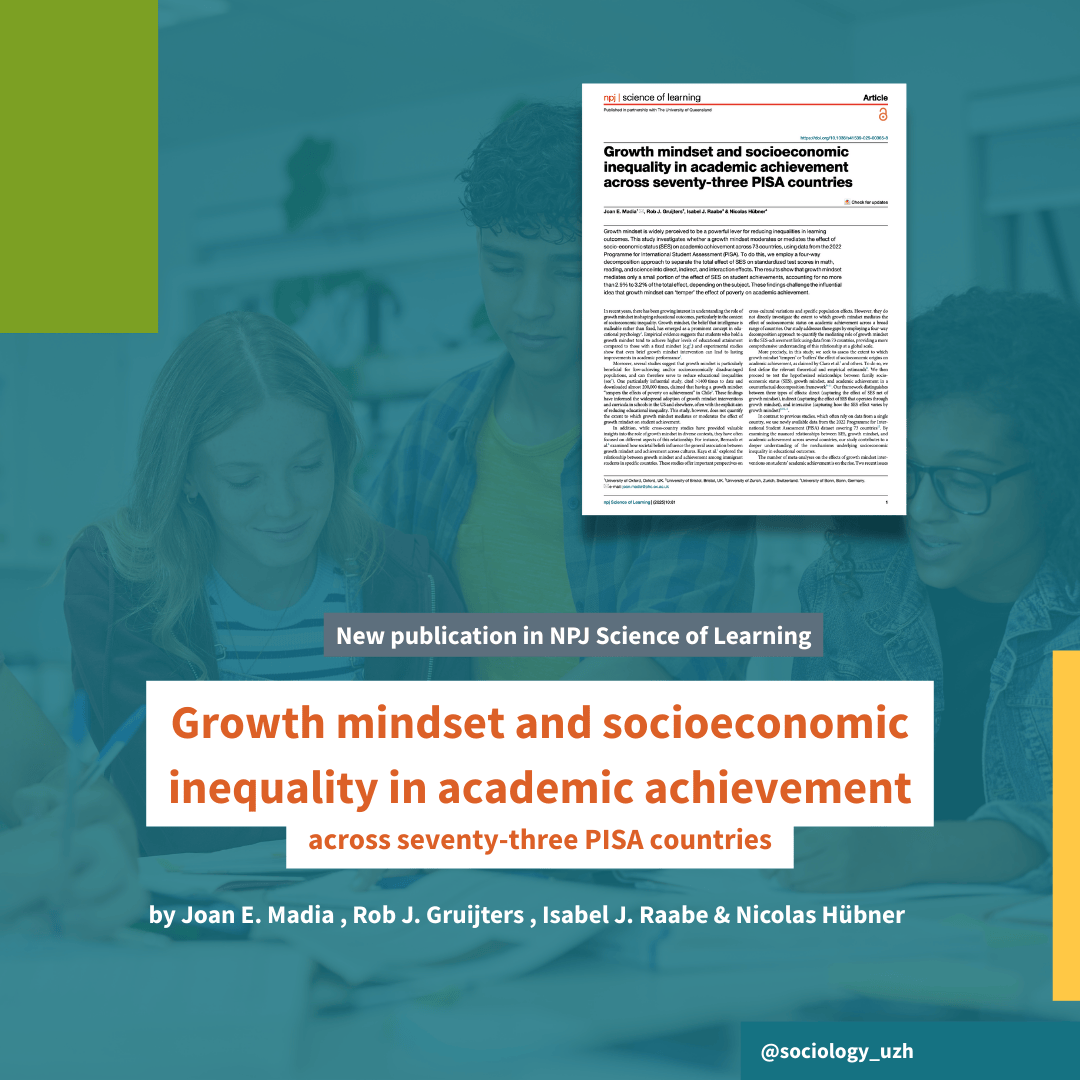
Dr. Isabel Raabe has collaborated on a paper that was published in NPJ, Science of Learning.
Abstract
Growth mindset is widely perceived to be a powerful lever for reducing inequalities in learning outcomes. This study investigates whether a growth mindset moderates or mediates the effect of socio-economic status (SES) on academic achievement across 73 countries, using data from the 2022 Programme for International Student Assessment (PISA). To do this, we employ a four-way decomposition approach to separate the total effect of SES on standardized test scores in math, reading, and science into direct, indirect, and interaction effects. The results show that growth mindset mediates only a small portion of the effect of SES on student achievements, accounting for no more than 2.9% to 3.2% of the total effect, depending on the subject. These findings challenge the influential idea that growth mindset can ‘temper’ the effect of poverty on academic achievement.
Madia, J.E., Gruijters, R.J., Raabe, I.J. et al. Growth mindset and socioeconomic inequality in academic achievement across seventy-three PISA countries. npj Sci. Learn. 10, 81 (2025).
Read the full open access article here: https://doi.org/10.1038/s41539-025-00365-8