«Eudaimonic and hedonic well-being orientations motivate ethical buying in Switzerland and Japan» - new article by Makiko Hashinaga, Patrick Schenk, and Jörg Rössel
Does the tendency to aim for virtue and meaningfulness – despite challenges – or the inclination to focus on short-term pleasure lead to more ethical consumption? In a new research article by Prof. Dr. Makiko Hashinaga,, Dr. Patrick Schenk, and Prof. Dr. Jörg Rössel, the authors investigate the motivational foundations for ethical consumption in Switzerland and Japan.
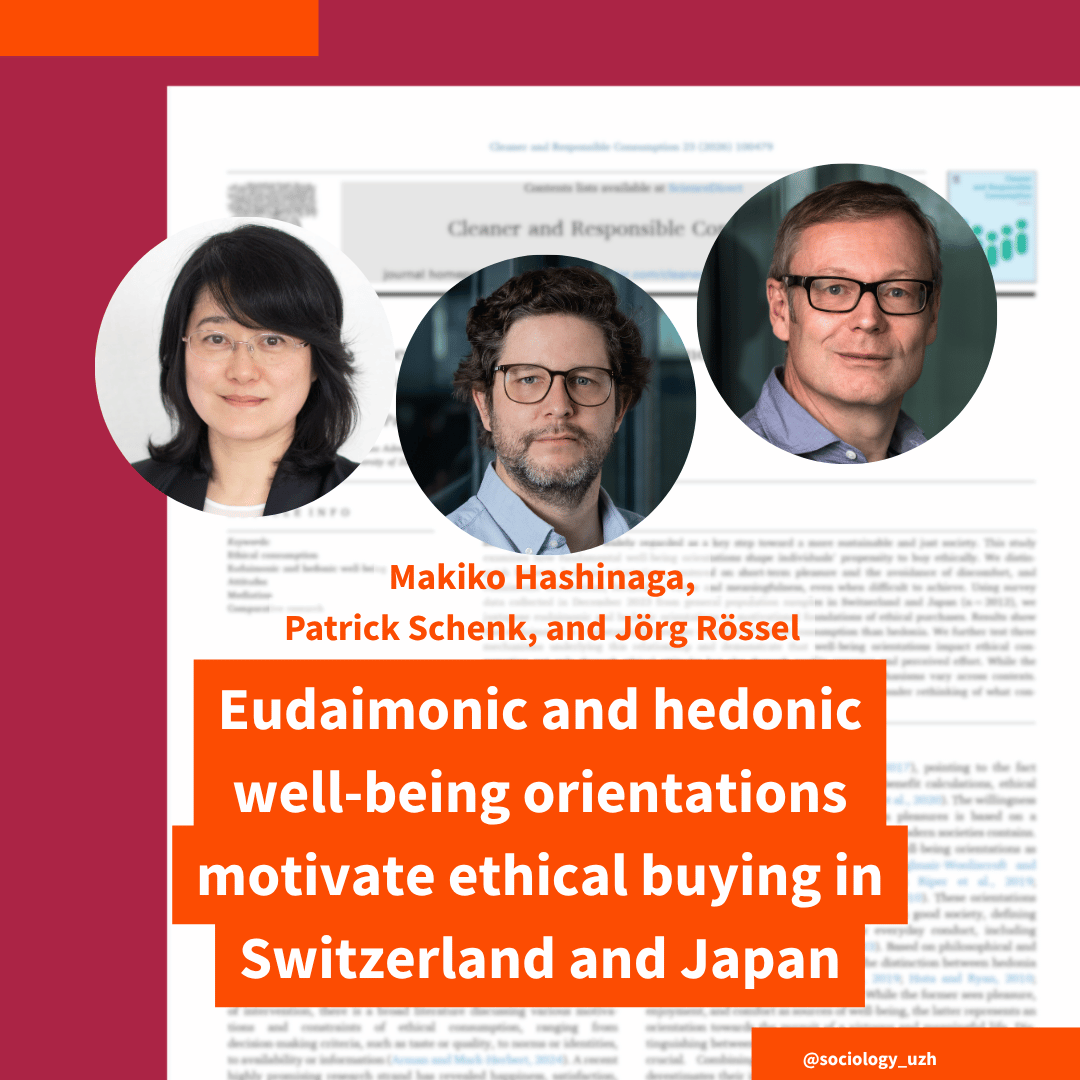
Eudaimonic and hedonic well-being orientations motivate ethical buying in Switzerland and Japan
First published August 4th, 2026 in Cleaner and Responsible Consumption
Makiko Hashinaga (Sapporo Gakuin University),Patrick Schenk (SUZ), and Jörg Rössel (SUZ)
Abstract
Ethical consumption is widely regarded as a key step toward a more sustainable and just society. This study examines how fundamental well-being orientations shape individuals’ propensity to buy ethically. We distinguish between hedonic orientations, centered on short-term pleasure and the avoidance of discomfort, and eudaimonic orientations, focused on virtue and meaningfulness, even when difficult to achieve. Using survey data collected in December 2023 from general population samples in Switzerland and Japan (n = 2012), we juxtapose eudaimonic and hedonic orientations as motivational foundations of ethical purchases. Results show that eudaimonia is a substantially stronger correlate of ethical consumption than hedonia. We further test three mechanisms underlying this relationship and demonstrate that well-being orientations impact ethical consumption not only through ethical attitudes but also through quality concerns and perceived effort. While the central role of eudaimonia is supported in both countries, the mediating mechanisms vary across contexts. Overall, the findings suggest that ethical consumption should be rooted in a broader rethinking of what constitutes a good life in modern consumer societies.