What drives scientific misconduct? A new study by Vincent Oberhauser, Antonia Velicu, and Heiko Rauhut identifies alienation and weakened social norms as key factors
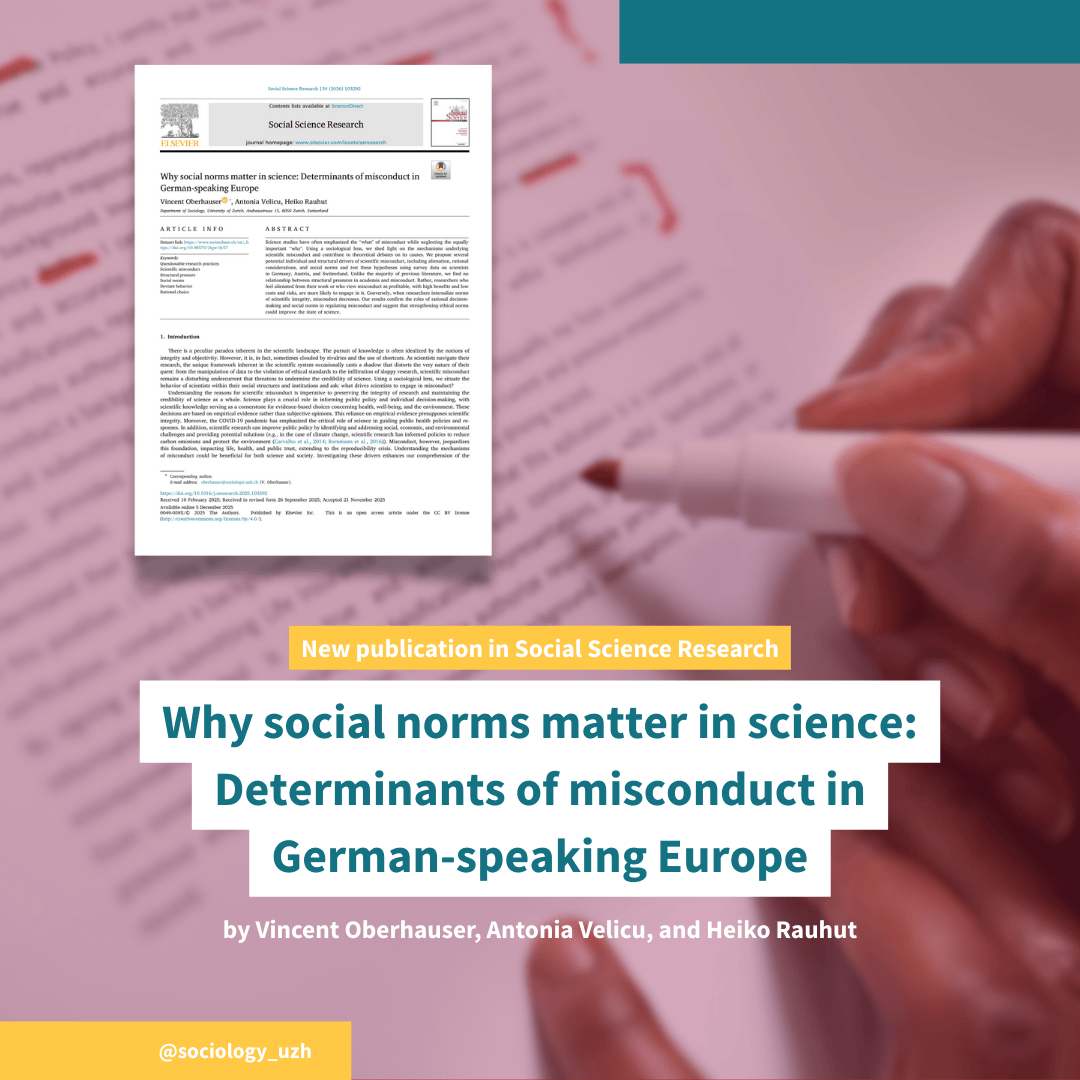
Why do scientists engage in misconduct and what are individual and structural drivers for this behavior? In this new study, the authors examine the hidden social dynamics behind questionable research practices and severe scientific misconduct. Drawing on the Zurich Survey of Academics with survey data from scientists in Germany, Austria, and Switzerland their findings challenge a widespread belief: it’s not just structural pressure, but feelings of alienation and internalized social norms that shape behavior in science. The study sheds new light on how integrity, norms, and rational choice intersect, and what that means for the future of research culture.
Misconduct in science might be more about disconnection than anything else. That’s what researchers Antonia Velicu, Vincent Oberhauser, and Heiko Rauhut suggest in a new study published in Social Science Research. Long-term job insecurity, intense competition, and a lack of clear support can leave researchers feeling disconnected from their work. When people don’t feel seen, valued, or part of a strong academic community, they may start to care less about the rules that keep science honest.
The study also finds that strong norms can lead to a notable difference. Scientists who truly believe in research integrity, and who see those ethical standards as non-negotiable, are far less likely to cut corners. But when those norms feel flexible, conditional or context-dependent, the chances of misbehaviour rise. The takeaway? To reduce misconduct, universities and institutions should focus on building a culture on education on research integrity, increase the community feeling, and ethical clarity. Rather than treating misconduct as a fringe issue, the authors call for a shift in how institutions train, support, and socially embed researchers at all levels.
The findings are based on one of the largest surveys of scientists in German-speaking Europe, the Zurich Survey of Academics. Over 15,000 researchers from Germany, Austria, and Switzerland took part, offering honest, and sometimes uncomfortable, insights into their experiences. Nearly half admitted to questionable research practices, such as adding authors who didn’t contribute or citing others to gain favor. More serious forms of misconduct, like data fabrication or plagiarism, were rare but still present. Lastly, the anonymized data from this study has been made openly available on SWISSUBase:https://doi.org/10.48573/bsxy-v618.
Why social norms matter in science: Determinants of misconduct in German-speaking Europe
Vincent Oberhauser, Antonia Velicu, Heiko Rauhut
First published online December 5, 2025 in Social Science Research
Read full article here: https://doi.org/10.1016/j.ssresearch.2025.103292
Abstract
Science studies have often emphasized the “what” of misconduct while neglecting the equally important “why”. Using a sociological lens, we shed light on the mechanisms underlying scientific misconduct and contribute to theoretical debates on its causes. We propose several potential individual and structural drivers of scientific misconduct, including alienation, rational considerations, and social norms and test these hypotheses using survey data on scientists in Germany, Austria, and Switzerland. Unlike the majority of previous literature, we find no relationship between structural pressures in academia and misconduct. Rather, researchers who feel alienated from their work or who view misconduct as profitable, with high benefits and low costs and risks, are more likely to engage in it. Conversely, when researchers internalize norms of scientific integrity, misconduct decreases. Our results confirm the roles of rational decision-making and social norms in regulating misconduct and suggest that strengthening ethical norms could improve the state of science.