Prosocial environments promote individual success - a new study by Isabel Raabe, Alexander Ehlert, René Algesheimer, and Heiko Rauhut
Does altruism lead to success? The study of 292 students across 16 Swiss school classes shows that altruism doesn’t improve grades directly. Instead, altruistic students are more likely to become embedded in prosocial friendship and cooperation networks, and it is this social embeddedness that predicts better academic outcomes. In short, altruism pays off through the social environments it helps create, highlighting how individual costs can be offset by collective benefits.
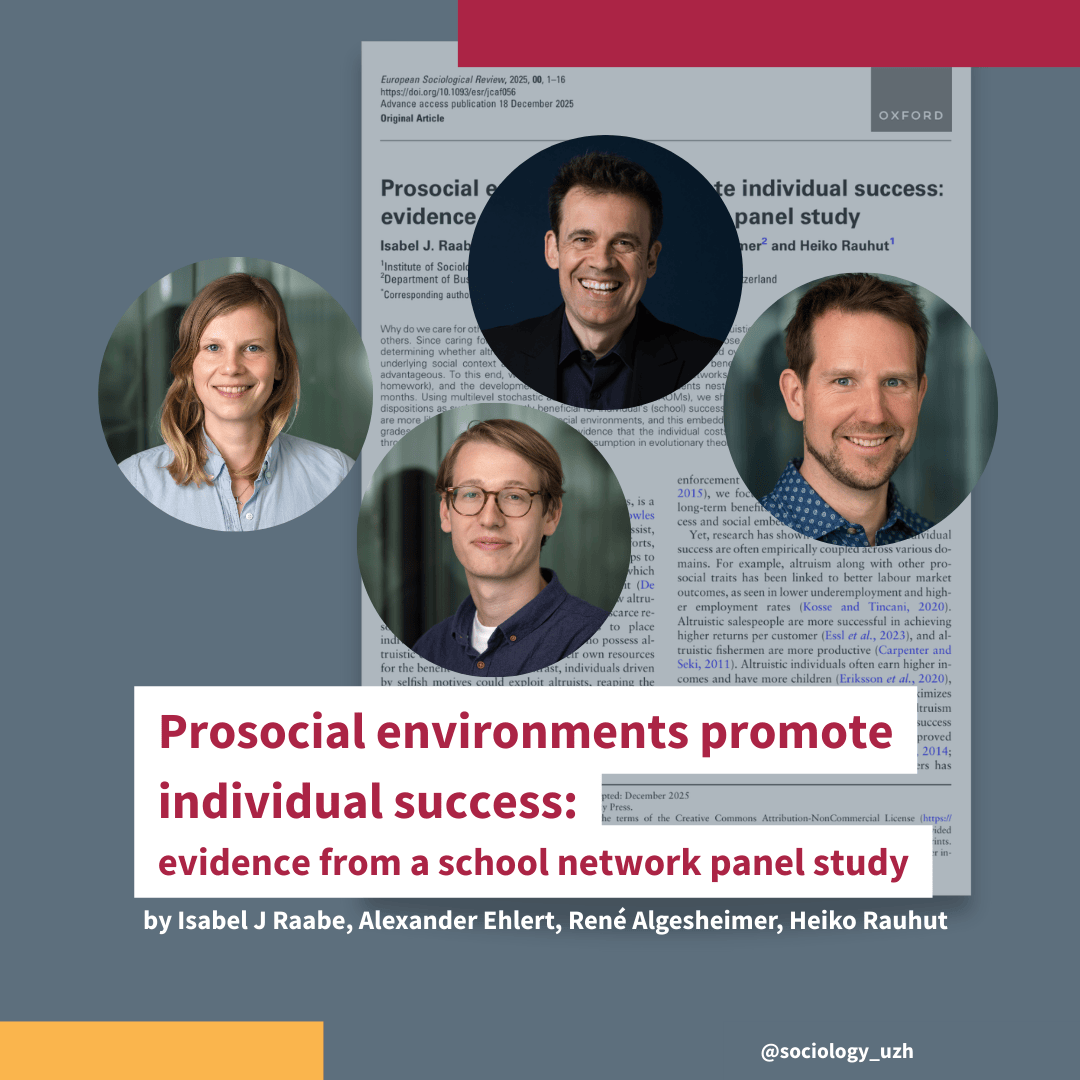
Prosocial environments promote individual success: evidence from a school network panel study
Isabel J Raabe, Alexander Ehlert, René Algesheimer, Heiko Rauhut
First published online December, 18 2025 in European Sociological Review
Read full article here: https://doi.org/10.1093/esr/jcaf056
Abstract
Why do we care for others? Several studies have shown that people holding altruistic dispositions tend to be more successful than others. Since caring for others is often costly, theoretical arguments propose that the social context plays a crucial role in determining whether altruism is advantageous and, thus, can be sustained over time. Our study empirically investigates the underlying social context and mechanisms by which altruism can be beneficial for individual’s success and therefore be advantageous. To this end, we study altruistic dispositions, social networks of friendship and cooperative acts (support with homework), and the development of school grades of 292 students nested in 16 school classes in Switzerland over five months. Using multilevel stochastic actor-oriented models (SAOMs), we show field evidence indicating that bearing altruistic dispositions as such is not directly beneficial for individual’s (school) success. Instead, it matters indirectly. Altruistic individuals are more likely to be embedded in prosocial environments, and this embeddedness is crucial for individual success, i.e., school grades. These findings provide empirical evidence that the individual costs of altruism can be offset by collective benefits through social embedding, supporting a core assumption in evolutionary theories of cooperation.